
How Modern Football Shoulder Pads Improve Performance:
Advanced Foam, Impact Absorption, and Cooling Technologies
June 8, 2026
For years, football shoulder pads were judged by one standard: did they look big enough? Bulk meant toughness, and heavier felt more serious. Players, coaches, and parents alike accepted that stiffness, weight, and discomfort were simply part of suiting up. That tradeoff made sense when there was no alternative.
The game has changed, and so has the equipment built for it. Today’s football is faster and more dynamic, with athletes moving in ways that expose every flaw in a poorly designed pad. Protection still matters, and it always will, but for today’s game, the best protection now has to work with the athlete, not against them.
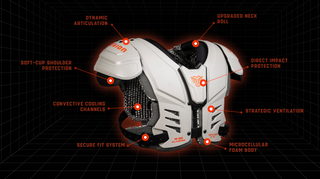
LEGION’s modern padding technology addresses this through three primary areas that, taken together, define elements of a high-performance shoulder pad: the technology of the internal foam system, how the pad’s exoskeleton structure covers for and responds to impact, and how the pad system manages heat. For players, parents, and coaches evaluating equipment, these are the categories that separate yesterday’s pads from what the modern game actually demands.
The Problem with Traditional Pad Construction
Anyone who’s played in older-style pads knows what they feel like: stiff out of the locker room, hot by the second drive, and heavy in a way that has nothing to do with protection. Those complaints weren’t just about comfort; they were symptoms of padding built around a philosophy that prioritized mass over function.
Traditional pad construction focused on how much material it could put between an athlete and contact. The maximalist idea of traditional shoulder padding was fine for protection, but the byproducts were accepted as inevitable: restricted movement, poor ventilation, moisture retention, and slow drying. Players dealt with them because the alternative was less protection.
Modern pad engineering rejects that tradeoff. At LEGION, our goal wasn’t to find a middle ground between protection and performance. It has always been to build a system where one reinforces the other.
Modern Foam Design: What’s Actually Inside the Pad
The internal material is where pad performance lives. Everything an athlete notices about a pad—how it moves, how it breathes, how it responds to a hit—traces back to the design of the foam system.
Traditional foam does its job by existing. Conventional theory was that more material meant more buffer from impact, and for decades, that was pretty much the exclusive consideration. The problem is that bulk-oriented foam has its side effects: it holds heat, resists airflow, absorbs and holds sweat, which generally makes the pad feel like something the athlete is carrying rather than wearing. This video demonstrates just how much of a difference LEGION’s modern technology can make for players, compared to traditional padding.
LEGION’s foam system is designed around how athletes move on the field, not around just being a protective barrier. That distinction matters because a pad built for movement behaves differently from one built purely for coverage. It sits differently on the body and responds differently when the athlete spins, cuts, or takes contact. The goal is a pad that doesn’t have to be fought against, one that works alongside the athlete rather than adding resistance.
What Players Actually Notice
Players don’t describe gear in engineering terms; they’re more likely to describe it in terms of feel. The reactions that come up most consistently when comparing modern foam systems to traditional construction tend to sound like:
-
“These don’t feel like I’m wearing pads.”
-
“I can actually move my arms.”
-
“They’re not fighting me.”
-
“These feel different.”
Sometimes that’s all you’re going to get out of today’s youth, but it’s the clearest signal that the pad is doing its job without creating friction. A pad that doesn’t interfere with movement is one that the athlete trusts, and trust is the difference between gear worn correctly and gear worn reluctantly.
For parents, the practical version of this is simple: pads that feel lighter and less oppressive are pads that get worn consistently and worn right. For coaches, it means players aren’t adapting their movement to accommodate equipment limitations.
Impact Absorption: Why Bulk Isn’t the Same as Protection
This is one of the most persistent misconceptions in football equipment: the assumption that a bigger-looking pad is a better-protecting pad. It’s an understandable assumption, as more material looks more serious. But protection isn’t about volume; it’s about response.
Impact absorption describes how a protective system manages contact energy. When a collision happens, force travels through the pad toward the athlete’s body. The question isn’t how much padding exists in the path. It’s how well that padding disperses the energy before it arrives. A pad can look substantial and still transfer force poorly. A more refined system can be lighter and more mobile while handling contact more intelligently.
The Reality of Contact in Football
Football contact is violent. Any attempt to gloss over that is frankly disingenuous. Players take direct hits, glancing blows, and repeated contact across the course of a game, with collisions happening at a range of angles and speeds. As opposed to the bulky pads of years gone by, modern pads should be engineered to move quickly without sacrificing protection.
LEGION’s design philosophy starts from that reality. Rather than engineering for the most obvious use case and accepting gaps everywhere else, the system is built to respond across the range of contact that happens on a football field. That means thinking about how the material behaves when force comes in at an angle, when it comes repeatedly, and when it comes at speed in open space. In this video, our lead engineer, Curtis Cruz, walks you through how LEGION’s padding is built for real-world performance.
Why Coaches and Parents Should Think About This Differently
The instinct to equate visible size with protection is worth examining. A pad that’s too bulky or too stiff creates its own problems: athletes notice the discomfort before they appreciate the coverage, which leads to poor fit over the contours of the body, movement compensations, and a general attitude toward the equipment that’s more about tolerating it than trusting it.
A smarter impact system earns trust by performing without getting in the way. The better question when evaluating shoulder pads isn’t “How big do these look?”. Instead, it’s “How are these designed to respond when contact actually happens?” and “Do these enable or inhibit the athlete’s fast and fluid motion?”.
Cooling and Airflow: A Performance Feature, Not a Comfort Add-On
Heat management in shoulder pads tends to get discussed as a comfort feature, as if it’s nice to have but secondary to protection. That framing undersells the problem. Heat accumulation directly affects how athletes perform, especially in the second half of a practice or game.
Shoulder pads cover the upper torso, shoulders, and upper back, a significant surface area where heat builds and sweat concentrates during any extended physical effort. That’s especially true in warm-weather states and in those summer two-a-days. The heat is not a minor inconvenience. It is a sustained tax on the athlete’s stamina and focus.
Heat illness in football isn’t theoretical. Players at every level have died from it, and the sport has spent decades updating its protocols as a result. Korey Stringer’s death at Vikings training camp in 2001 forced a reckoning across the NFL and eventually down through youth leagues. Equipment that manages heat better isn’t a convenience feature. It’s part of a broader safety conversation the game has already been having, and any brand serious about player protection has to be part of it.
What Traditional Pad Design Does to Heat
Older pad construction was never built to prioritize airflow. Dense material, limited ventilation paths, and moisture-holding foam combine to create a sealed environment under the pad, which is exactly the wrong condition for an athlete generating heat during football activity.
Once heat and sweat have nowhere to go, the pad starts to feel damp, heavy, and sticky. Athletes dealing with overheated gear are focusing on their discomfort instead of the game. That erodes decision-making and stamina in ways that don’t always show up in obvious performance drops, but they’re there.
Beyond Heat Management: The Hygiene and Longevity Dimension
Anyone who’s spent time around football equipment knows what poorly ventilated pads smell like after two weeks of camp. That’s not just an unpleasant fact of football life. It’s a reality of traditional foam padding: material that traps moisture becomes a breeding ground for bacteria. Skin irritation, odor buildup, and the general misery of putting on cold, damp pads the next morning are all downstream effects of poor ventilation design. The sweat and bacteria also break down the padding over time.
LEGION Pads built to breathe and dry faster sidestep most of those issues. They’re not just more pleasant to wear, they’re easier to maintain and more hygienic across a full season.
LEGION’s Approach to Heat Management
LEGION’s cooling system is built on the premise that heat buildup under a pad is an engineering problem, not an inevitability. To effectively address this issue, our pad’s construction features patent-pending convective cooling channels. These are built into every pad we make to allow heat to escape and move hot air and moisture away from the body, unlike traditional pads, which seal it in.
The practical difference shows up where it counts: better focus deep into a long session, a lighter feel even after heavy sweating, and less of the “I don’t want to put these back on” dread that follows a particularly hot workout. The athlete who isn’t fighting their equipment is the one who plays harder, longer, and more consistently.
Why Modern Performance Design Matters for the Athlete Wearing It
There’s still a version of the shoulder pad conversation that revolves around how much coverage is visible. That version of the conversation is increasingly disconnected from what high-performance athletes actually need from their equipment.
Players want gear that moves when they move, breathes when they’re working, and handles contact without feeling like a liability. Coaches want pads that get worn correctly, not adjusted, fought against, or stripped off during breaks. Parents want equipment that reflects a real investment in the athlete’s performance and wellbeing, not just a check on a required gear list.
LEGION’s design answers those expectations by treating each of the three areas covered here as essential, not supplementary. The foam technology, impact response, and cooling architecture aren’t isolated features; they work together as a system.
Final Thoughts
Football shoulder pads have always been about protection. What’s changed is the understanding that shoulder pads have a bigger impact on a player’s game than just the hits they make or take.
The old standard was straightforward: wear something big enough and live with the rest. The modern standard is more demanding because the game has evolved, and we believe athletes deserve equipment that reflects that. Protection should respond intelligently to impact, not just absorb it. Materials should support movement, not resist it. Ventilation should be engineered into the design as a standard, not treated as a luxury or an afterthought.
That’s the design philosophy behind LEGION Protective’s shoulder pad systems. And it’s why the conversation around modern pads has moved past bulk as the primary measure of quality. In today’s game, the best protection isn’t just what shields the athlete. It’s what helps the athlete perform without thinking about what they’re wearing.